As the title of this article suggests, you absolutely do not need a fast charger to own an electric car.
People, mainly internet-based naysayers, get this idea that to own an electric vehicle, you need a big, scary power supply, a service upgrade, maybe even three-phase power.
The truth of the matter is, if the vehicle is efficient enough to suit your needs, you could actually get away with using just a regular 240V 10A, (that’s 120V 20A for our north American and Japanese friends) outlet for your day-to-day charging needs.
You want to know how I know this? Because that’s exactly what I use.
I live in a situation where I do not have a dedicated charging point right next to my vehicle. To get even a singular AC charger installed in the premises, it’ll cost approximately $50,000 for a single 7.2kW AC unit to be added to just one of our visitor bays for public use.
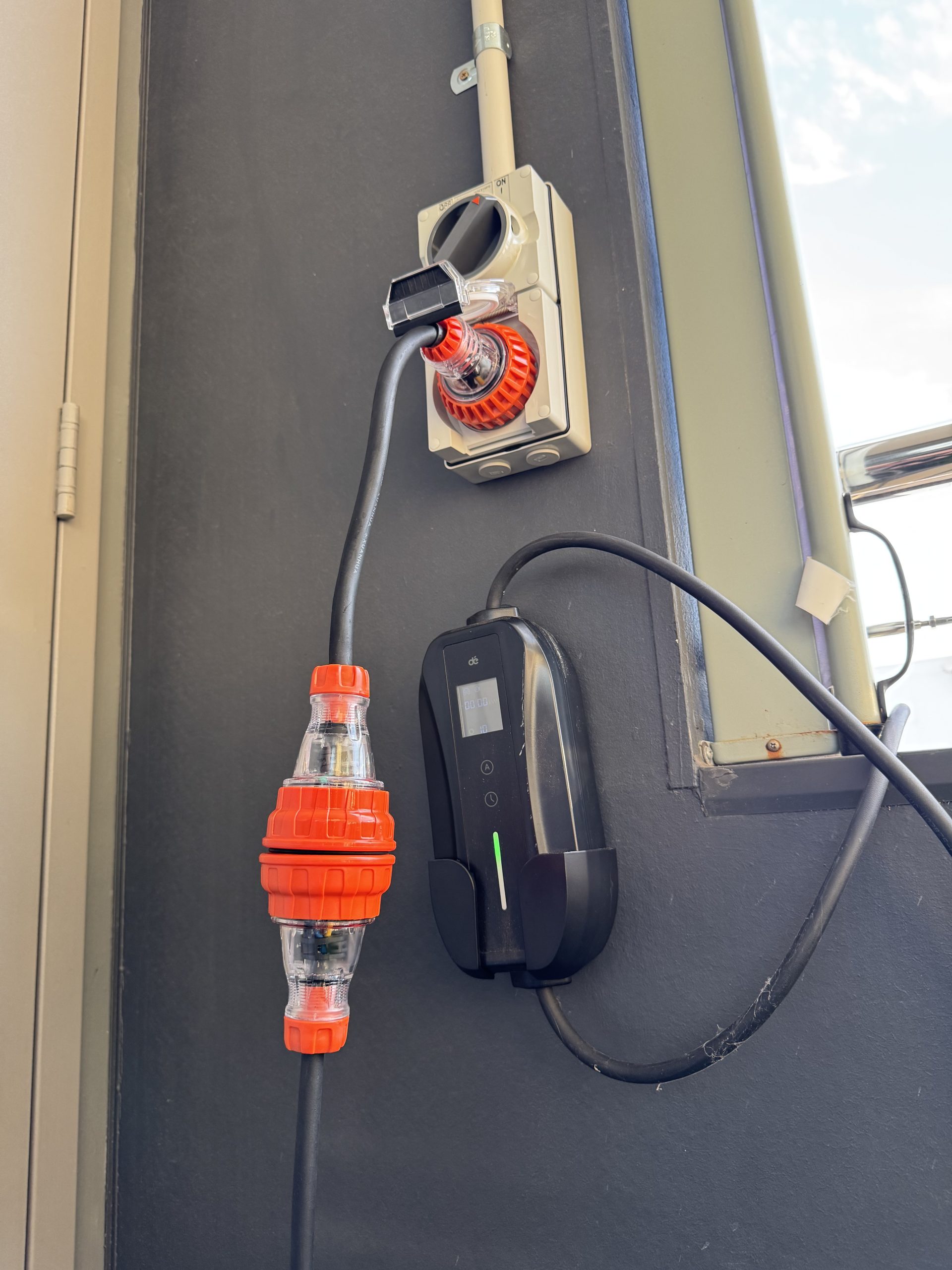
As a result, I drop a cable from my balcony to a visitor’s parking space down below, using a 15M long charging cable, connected to what appears at face value to be a rather scary looking industrial plug, but is, in fact, a regular 240V, 10A power socket in a suit of water and dust-proof armour of sorts.
We’re thinking about charging in the wrong way.
The real truth is, You only need a high powered, dedicated wallbox (such as a Zappi or one of Tesla’s Wall Connectors), if you own a particularly inefficient EV with a large capacity battery (such as say, a Hummer EV, BMW iX, Tesla Cybertruck etc), or you have a frankly, massive commute each day.
Think about how much time your car actually spends parked in a day. If you arrive at your home at around 6pm, and depart the next morning at say, 7am, to drop your kids off to school and to do a 9am-5pm workday, that’s about 13 total hours each day that your car spends parked.
Let’s say this commute begins in Ellenbrook. your kids go to school in Ellenbrook, and let’s say you work in a warehouse in the middle of Malaga. On the way home from work, you pick up some KFC for you and the kids because your kids got a good grade at a recent test, so you want to reward them.

Plugging this route into a tool called A Better Route Planner, gives you a rough idea as to how much battery your car will use to perform a specific routing. In this case, for a Tesla Model 3 Standard Range, a vehicle which is frankly, one of the most efficient EVs on the market, you’d use about 8% of that car’s battery capacity to make this trip. Now sure, 8% sounds like a lot, but it’s only got a 57kWh usable battery pack. That means you’re really only using about 4.6kWh of energy to make this trip. If you add say, a 20% hit to efficiency for winter? That’s still only 5.4kWh of consumed energy.
Consider that in Australia, a standard GPO has an output power capacity of between 2.2 and 2.5kW. Power and energy are two completely different things. Power is the amount of load a socket can handle, as in how much load the socket can take. For energy, you simply add a time component, you time how many hours the socket is drawing that particular load.
When you get your power bill from Synergy, you might see your power bill being issued in something called “Units”, this refers to Kilowatt-Hours, or kWh for short. Energy in batteries is also measured in this figure. a 57kWh battery means that if a 57kW load was connected to the battery pack, it’d take an hour to drain it, or if a 1kW load was connected to the pack, it’d take 57 hours to drain it.
The commute shown above is about a 40km commute. If we plug in the figures of how much distance we travelled, and plugged in how many kWh of energy we consumed, we can get an efficiency figure from that. In this case, we’re using 115Wh of energy for every kilometer we’re driving, or to translate this into terms you’re probably used to from your existing petrol-powered car, this car’s efficiency is around 11.5kWh/100km.
That 4.6kWh of energy can easily be recovered, with about a 70% efficiency rate (thanks to the car’s on-board AC-DC charging inverter losing some energy to conversion losses, as well as the pack being in a relatively high state of charge), in about 3.5 hours when plugged in to a standard 240V 10A socket.
This means you can plug your car in, have dinner, watch a movie with the kids, and the car would already be back to 100% full, all with the power of a regular wall socket.
in 8 hours, factoring in that same 70% loss ratio, you’d be able to recover around 12kWh of energy into your car’s battery pack. Yes, you’d lose a little due to those same conversion losses, but if you consider that above driving efficiency figure, you’d be looking at about a 100km round trip in the coldest winter months. That’s a solid 22% of the car’s battery pack capacity recovered in 8 hours.
If you plug in your car as soon as you get home, and don’t unplug until you leave the next day, letting it constantly charge for the 13 hours it’s plugged in for, that’s 20.93kWh in your battery pack, around 35% of the car’s total capacity, or a roughly a 150km roundtrip commute in the coldest winter months.
To make a 32A wall connector actually worth it for that Standard Range Model 3? You’d need to be living in Mandurah, and have to commute to Joondalup on a daily basis. You’d have to be driving for almost two and a half to three hours a day!
Consider this. The average Australian commute from home, to work and back home again is at most, 50km a day. This usually takes about 45 minutes to an hour, due to the average speed of cars being between 50 and 60kph on said commute.
So when should you actually get a wallbox?
Well, there are some very legitimate reasons for wanting a dedicated wallbox.
If you own multiple EVs, and you only have room to charge one at a time, this might be a good option, as you’d be alternating between which EV gets to charge, and which EV doesn’t charge each day. You’d actually go deeper into the pack on each of these cars, for example, if my partner and I owned two Teslas of the same spec, we’d be at about 80% of our car’s usable capacity before it was their turn to charge each day, meaning the car would only have to sit there for 2hrs before it gets full. The thing is though, because of the fast rate of these chargers, you could, in practice, get both cars up to 100% if you’re willing to do a little shuffling around.
If the EV you own is particularly inefficient or has a larger battery capacity, such as the likes of say, a BMW iX, Tesla Cybertruck, or Silverado EV, a larger charger is going to come in handy as it’ll be able to get more energy into the pack faster. But this also depends on if you use that vehicle to drive a long distance. Which leads me to my next point.
Certain professions that require the need for faster charging, such as tradespeople, sales representatives and real estate agents, who use their vehicles to go from place to place to place, making multiple stops and driving several hundred kilometres a day, would absolutely benefit from a faster charger, especially if your vehicle is not ideally efficient, such as say, a BYD Seal or Polestar 2. Whilst both of these vehicles are plenty capable of using a standard wallbox, the larger pack variants also tend to hit that mark for owners who mass commute with these vehicles to need a faster charger. If you also have a smaller packed vehicle that’s still efficient, like my Model 3 Standard Range, a faster charger will help you get back up to 100% even faster.
I would also consider a wallbox if you live in a particularly cold climate, especially where snow is a thing, such as the northern parts of North America, Asia and Europe, due to the lower voltage of standard power sockets, as well as the much greater impact that driving in sub-zero temperatures and driving on snowy, sleety, slushy roads has on overall efficiency.
Are there alternatives to Wallboxes?
Yes! in Australia at least anyways.
You can always get 15A sockets installed into your home. These sockets can provide up to 3.6kW of energy output, with an 80% efficiency output rate of about 2.8kW to the car’s battery pack.
These do require dedicated circuits, sure, but seeing as a standard home has a 62A supply, you’d only be consuming, at most, half of this supply under full load.
Alternatively, if you own multiple EVs, a pair of 240V 10A sockets will provide about 4.8kW of total output power to your car, around 2kW of charging power per socket (when factoring in losses), and it means you can recover more energy to multiple cars without the need for dedicated electrical circuit work. That’s enough to recover about 80-100km per car per 13-hour day of energy, if you’re using my Tesla as an example.
If you don’t have the space in your garage, or you simply want to park your EVs outside? Get your sparky to fit the kind of sockets I have listed above, with an IP66 rating. These are used often in workplaces, as a way to protect the cables from ingress from water, chemicals and dust. They also have a threaded collar on the plug to make them more difficult to remove, and the switches can be locked off so that when they’re not in use, your power can’t be stolen by your dodgy neighbours.
And if you’re worried about the charging you do overloading your paltry 62A service? Don’t. 62A at 240V is 14.8kW. You’d need to be running three air conditioners, an oven, an induction cooktop, your TV, a home theatre system cranked up to maximum volume, a PC, a CNC machine and then charge two EVs at the same time before you trip your house’s main breaker. 14.8kW is a frankly, huge amount of power. This is also why Tesla sells Powerwalls in a 13.8kWh battery capacity rating, as that’s the average level of overnight, summertime energy consumption for a pair of adults living in a regular sized 300-400sqm house. Hell, they only rate those at a 10kW maximum power draw, because 40A is still a lot of output draw at 240V.
In short, so long as you own an efficient EV, you are more than capable of using a regular wall socket to live with your EV on a daily basis. The best part? Most garages have a dedicated wall socket in them for powering tools and beer fridges and such, so as long as you’re not drawing more than 10A from the socket (ie, you’ve got nothing else plugged into it), you’re good to go with charging an EV.
But as always, do your research, especially when it comes to purchasing an EV. Just like how it is with ICEVs, I argue that efficiency is way more important than overall range for the large bulk of people, so keep this in mind when you go looking for your next car, especially if your charging requirements are restricted. You should always try to also aim for an LFP equipped car if you can find it in your market, as those packs can take a lot more abuse than their NCM/NCA counterparts.
Beano out.