Okay, so by trade I am absolutely not a designer of homes. I dabble more in product and graphic design myself, but I did promise myself after the previous post I made that I’d try not to get political on this post. In fact given that we’re nine days into 2026 and we’ve seen a year’s worth of international-level events already, it’s probably a good time to take a break from all the chaos and talk about some other things that really tick me off.
That’s right, i’m going to nitpick about some trends in modern house design that I really, really do not like. Keep in mind, this is my opinion, and as you can already tell, i’m a pretty opinionated little so-and-so at the best of times. If what you see or hear annoys you? Go complain about it on Reddit… Because I sure as hell won’t let you complain about it here, and since I’ve blocked pretty much all social media anyways, those screams are not going to fall on my ears anyways.
So let’s get stuck straight into it, shall we?
Bugbear No. 1: Sinks in Kitchen Islands.
Now, you might think this is cool and trendy, that sticking a sink in a kitchen island is something that’ll allow you to interact with your guests whilst you’re washing up the dishes or whatever… But the thing is, all a sink in the island is going to do is result in, is having dirty dish water splashing all over your nice, clean floor and into your guest’s drinks.
Yep, i’m going to say it. I fucking hate this trend of kitchen island sinks.
For one, sinks really only have three purposes in a kitchen. One, for filling water bottles and glasses so you can drink the water in the sink. Two, for washing and rinsing dishes that you’re likely just going to stick in the dishwasher anyways (in fact you really should be using a dishwasher to wash your dishes these days, it’s more hygenic and it saves you time.) and three, for washing veggies.
The biggest problem is with a sink is that water tends to fly around everywhere when you wash your dishes. Water is the thing i hate the most in housing. It can damage your kitchen cabinetry and furniture if there’s a leak that isn’t stopped, it introduces mould, it presents all kinds of problems if you don’t manage it properly. Sticking a water pipe in a concrete pad, one which might need to be maintained from time to time, is a horrible idea, as once again, water is just something that likes to get everywhere it can. One leaky pipe in your concrete pad can result in damage to your pad, which can potentially cause some pretty serious structural issues that may be expensive to fix.
On top of all this, they seriously cut into your benchtop’s usable space, meaning whilst people may feel that this makes the space more social, in reality it actually just makes it even more antisocial, and it also makes the benchtop way less usable, by making the seating area for two of your guests effectively useless for eating.
So, what’s my fix to this issue?
Put a cooktop there instead!
“What? That’s dangerous.” you’re probably thinking. and that may be correct, if you use say, a Gas or Ceramic cooktop. But I recommend that any new build should use an induction cooktop, regardless of your feelings about how much you enjoy seeing the fire or whatever. Induction is a superior cooking technology that even professional chefs are starting to lean towards due to its safety, thermal efficiency, and precision temperature control over gas or ceramic.
Induction is more efficient as a cooking technology because it heats up the cookware, it’s more precise due to the fact that it can passively sense how hot the cookware is without overheating any sensing equipment, its safer due to the fact that the cooking surface itself gets less hot than a ceramic cooktop, and it’s both cooler and safer for cooks, because of the fact that burning gas puts out noxious carbon monoxide and also poses a potential fire hazard for your home.
So, what about all the steam and oil and such? Well, that’s where one of these bad boys comes in to play!

This is a downdraft induction cooktop. Essentially instead of a rangehood, a powerful motor pulls air downwards, through the countertop via a rear filtration channel, and pushes it out underneath the island via a vent in the kickboard. Since there’s no methane, carbon monoxide and nitrogen oxides being emitted by the stove, it means that all you’re really dealing with is fat and water particles from your food. If those can be pulled back down and filtered out of the air using an activated carbon filter that’s accessible for replacement through a rear door in the cabinet.
Yes, this is expensive compared to other induction cooktop options, But it ends up being the same price, or even cheaper than the cost of a decent quality cooktop and a rangehood combined.
The other benefit too of using an induction hob in your kitchen island, is that you are running electrical connections through your floor as opposed to water connections. This requires less work, and if you use an oversized conduit channel, you can more readily replace a worn or aging electrical cable way easier than replacing a worn and leaky water pipe. All you’d need to do is to get your electrician to fish the cable through the floor. Just make sure when you install one of these things, to install wider conduit than usual to make their lives easier.

Also, if you’re like me and you enjoy a delicious steaming hotpot in winter, it means you and your mates can sit around the hotpot without needing to buy a separate induction hob for your table. You can simply have your guests sit at the kitchen island. Most people in China these days cook hotpots on one of these little induction hobs anyways, so you may as well save yourself the $50 and incorporate it into your island bench.
So yeah. Screw putting a sink in your kitchen island, it’s better to have a cooktop there instead.
Bugbear No. 2: Poorly laid out bedrooms
Nothing ticks me off more than a bedroom that I cannot fit a King Sized bed, nor a custom wardrobe into. I honestly think bedroom layouts should be standardised so that wardrobe cabinetry can be fitted to a room. Nothing annoys me as much as those silly, wasteful “built-in-robes” builders like to spec into rooms. They cut into the space of the bedroom, restrict what types of drawers or cabinets you can put in them, and force you to make compromises.
I even dislike those bedrooms with wardrobes that go behind your bed. They’re excessive and encourage people to buy more clothes than they actually need. They’re basically designed to make Marie Kondo extremely joyless.

So, what’s my fix to this issue?
Standardise bedroom layouts by making bedrooms four meters by four meters in internal size.
Think about it. A King-sized bed? That’s about 1800mm wide, plus a decent bed frame, that makes it say, 2000mm wide. Lengthwise? A King sized bed in a frame takes up about two-and-a-half or so metres, give or take. Side tables are about 40 to 60cm wide and about 40cm deep. Let’s reserve 1.2M in total width for those too.
IKEA PAX Wardrobes are sold in 50cm and 100cm unit widths. Allocate 1x 100cm and 1x50cm cabinet for each person who’s in that room. Depthwise? They occupy about 60cm of depth, and with any drawers open, a total of about 100cm. Likewise if you use a similar system like the Vitsoe 606.
Drawing this layout gives you this as a result:
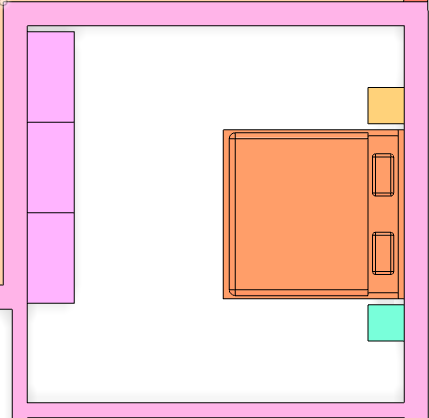
This is an absolutely massive room, giving you a total of 16sqm of floor space, and huge amounts of area for things like vanities, dresser tables, etc. Not that you’d need them, because your bed’s also going to have storage underneath it. This layout assumes we’re using IKEA products throughout, with MALM bed frames and side tables, and PAX wardrobes, but you have tons of room for whatever type of furniture takes your fancy.
Reserve a total of 1sqm of floor space for either a swinging or sliding door, and you have a spacious, easy to organise bedroom that’s easy to find furniture for. On top of that too, you can even choose to extend those wardrobes into the corner a bit more if you choose to say, sacrifice some wall space. Dear Modern won’t think this layout is Feng Shui at all, but Feng Shui, whilst it does have some practical use in terms of being a somewhat understandable guideline to make rooms that look somewhat nice, is rooted in pseudoscientific beliefs that spaces have “energy” of sorts.
Despite the Feng Shui belief, for example, that your bed should not face the door, I believe that this is ironically the best way to have your bed oriented. Likewise, placing a narrow window above your bed is in my opinion, a good thing, as it lets light in whilst also making ingress more difficult for intruders. Your bed should be oriented in a way that makes for the easiest ingress/egress from the bed to the other rooms, and also does so in a way that protects you from intrusion from would-be thieves.
On top of this too, having a standardised bedroom size means that it’s easier to modularise a house, meaning it can be built in blocks or sections, and additionally, it makes buying things like desks way easier, as those are generally sold in 120 or 150mm widths, meaning you can fit storage cabinetry between desks a lot easier as well. It means you can build your bedrooms to be offices if you choose to. You can put in a couple of single beds for your kids and have tons of room for them to play on the floor. Having bigger rooms means you can also have less bedrooms and still have a nice, usable home for say, families with more than two kids.
Speaking of useless rooms…
Bugbear No. 3: Theatre rooms in general.
I know, this is going to piss off a lot of people, but hear me out. You do not need a theatre room. Despite his bellyaching about how “non-immersive” watching movies on a iPad is, i can say, as a video producer myself that David Lynch is a posh, pretentious twat who doesn’t understand that people these days, at large consume media on mobile devices more than they do televisions. On top of this, televisions encourage double-screening, wherein your TV acts as nothing more than a background noise machine. Netflix is even going so far as to create content specifically intended for double-screening.
So, if you need a room where you can scroll while you watch anyways, is a Theatre Room even necessary? The entire point of a theatre room is to enjoy movies in as close of a cinema experience as possible. If you’re the kind of arsehole who texts in a movie theatre, honestly you deserve to be shot into space on a Falcon 9 straight into the fucking sun.
So, what’s my fix to this issue?
Nix the theatre room all together and make your kitchen/living/dining room a single space.
You may as well save your cash, subscribe to YouTube Premium, (or better yet, set up a Plex server and sail the seven seas for content) and background play videos whilst idk, scrolling facebook or whatever other social media brain-poison you choose to indulge in these days anyways, and then if you do want to enjoy the odd movie or two alone or as a couple, get yourself a couple of pairs of Airpods Maxes, and pair them to an Apple TV in your Living area. You’ll get way more immersive sound, and still be able to enjoy the movie as those posh Hollywood twats intended. Better yet, get a Frame TV of some sort and use it to display family photos and such when it’s not in use, so your TV serves a greater purpose than to be a $3000 content ignorance device.
Save yourself the extra design complexity and just put your damn TV in an open plan living area. Yes, the sound from your speakers is not going to be great. But let’s be freakin’ honest here. You aren’t watching TV or movies in the theatre room unless you’re an avid movie enthusiast… And even then, the cost of building out a proper theatre room that’s going to have sound good enough to be immersive whilst also not pissing off your neighbours at the same time will literally be the same cost as it would be to just go to the movies once a week for the rest of your life, and you’d get better sound there anyways. The amount of effort and cost to put in a decent quality theatre room, only for a new video format or standard to make the thousands you spent on completely redundant is honestly bewildering to me.
4K as a medium hasn’t even been made an official broadcast standard, let alone a standard for home movies, with most Blu-Rays still are sitting at 1080p. You don’t need a big honking 4K telly in a space that’s almost never going to be used as a room exclusively for video content consumption. It’s better to just nix the TV all together if you can, but if you can’t? Just put it on a nice TV stand and get one that’s modestly sized for your space. Honestly 55″ is all most people really need. Take it from a professional content creator here.
The same goes for dedicated Games Rooms too. You may as well just add another bedroom at this point, or better yet, stick your pool table where people are actually going to be mingling and talking with each other… You know, in the living area?
Bugbear No. 4: Enclosed garages.
The amount of times i’ve seen people spec out an enclosed garage, only for their excess crap to occupy the floorspace of the garage, forcing one of the cars out onto the street, is almost a meme at this point.

It no longer becomes a car-hole for your cars. It becomes a crap hole for your excess crap over time, and your cars just end up cluttering the kerb or the area outside your home or whatever. This means you waste more water cleaning your cars. It means you waste more fuel/electricity cooling your car’s cabin down. It also means you have a nice little container filled with Carbon Monoxide or Hydrogen Gas (depending on your car type) just festering away with no ventilation too.
So, what’s my fix to this issue?
1: Design your home with a carport in lieu of a garage
2: Put your tools in a shed
3: Put your excess crap in an attic, or better yet, sell it.
This will rattle people a little. Mostly because firstly, I don’t see the point of garages when certain cars are borderline theftproof anyways, and secondly, people rarely even park two cars in a two-car garage anyways.
Carports are cheaper, offer better ventilation, offer adequate protection from the rain and sun, and if you spec them right, can even be better for electric vehicles because you can equip them with additional solar panels to charge them.
Garages also encourage clutter too. Since modern cars are getting too big to fit in most garages anyway, you can build out a carport that’ll fit your car way better for the same price, and then use the land space and the cost saved from nixing the garage to build out an attic for your more important valuables (making them even harder for thieves to steal than items in a garage) and then putting things like your tools in a suitably secure shed out the back.
I’d also try to sell your stuff or donate it if you’ve got too much. Remember, if it does not serve a purpose, does not form a part of a hobby or interest, or is not a truly sentimental thing (such as something a departed or dear friend or relative gave you) it doesn’t need to stick around. Sell it, get rid of it. Decluttering is good.
On top of that too, given the fact that vehicles in general pose fire risks, placing vehicles in an enclosed space where fire can spread into your main home’s roof can potentially cause vehicle fires to do more damage. If a vehicle fire, despite how rare it is, does happen, having a space where the gases can ventilate out of and the flames won’t touch your home is way better than to have said fire contained in a small box where the flames can make their way into your roof space, your insulation, and then the rest of your house. This is fundamentally important in Australia where fires can be (and currently are as of the time of writing) devastating to homeowners.
This also goes without saying that flammables and lithium ion batteries ideally should not be stored near or next to each other. This includes things like putting your e-scooter in the same place as your car, for example.
Speaking of fires, this one’s also going to tick some people off.
Bugbear No. 5: Lightweight Timber frames.
Yep. You heard me, the current world’s most beloved construction material, renowned for its sustainability and carbon-negative nature, is ironically enough a rather shit choice for housing construction, in my opinion.
If you do wish to go with a lightweight construction method, Steel is structurally superior to timber as it is stronger per kilogram than timber is. It won’t twist, warp or be attacked by termites, it’s fire resistant, and if constructed, corrosion-proofed and utilised properly, it may even be cheaper in the long run.
Some homebuilders, especially here in WA will tell you that there is no termites in x area or y area or whatever. the reality is, Termites are fucking everywhere here. They said there’s no termites where I live, but my mum’s home, which is a mere 5 minute drive from where I currently live, ironically enough, got attacked by termites, resulting in the need for costly renovations.
Timber frames also need to be both pressure treated and chemically treated with something called CCA. What’s CCA you ask? Copper Chrome Arsenate. That’s right! If you build with timber frames, there’s now literal Arsenic in your walls. Copper is used to keep fungi at bay, Arsenic kills termites and ants, Chromium is used to bond them to the timber.
Arsenic and Chromium (Notably its Hexavalent ionic variant) are also known carcinogens as well.
This is why if you’re an owner-builder and choose to use timber framing, you ideally should be wearing PPE and gloves when handling this form of timber. Trust me, it’s nasty stuff.
So, what’s my fix to this issue?
Use steel framing in lightweight constructions.
If you do decide to go with a lightweight construction, Steel frames are way, way easier to install, assemble, and maintain. Better yet, they don’t leach toxic chemicals into your walls, and the best part? if you’re an owner builder, these steel sections can be shipped to your home as a kit or in prefab modules, meaning there’s also the potential that you could save thousands off of your home’s building costs. Also for owner-builders, the safety risks associated with metal framing and controlling particulates are way easier if you’re working from scratch, as Truecore framing generally doesn’t require the use of grinding tools to cut, tinsnips do the job just right, and provided you wear gloves and adequate eye protection? it’s way safer than timber to build with.
Steel is also more recyclable than treated pine, as it doesn’t contain those nasty chemicals which make recycling CCA timber a nightmare. Whilst yes, wood is renewable, it only is renewable insofar as you can keep growing it. Once it’s treated and erected, recycling treated timber is awfully difficult.
Steel offers the ease of service-running that electricians and plumbers crave, it offers the strength that roofers and solar installers love, and with suitable cladding, thermal decoupling, sarking and insulation, can prove to be just as if not more performant than timber.
And if the cosy sound of rain falling on a tin roof makes you happy (which by god it absolutely does make me happy) Steel framing carries that sound into your walls way better than timber does too.
Speaking of tin rooves… I got a bone to pick with a certain kind of roof.
Bugbear No. 6: Hipped Roofs.
You mean to tell me, that the humble Hipped Roof pisses you off?
Yes. Hipped roofs suck. The most common type of roof that you see in most modern developments is in my opinion, pointless unless you live in an extremely windy area, and even then, those can be fixed by simply going back to tradition.
So, what’s my fix to this issue?
I argue that most home should have gabled or skillion roof designs.
This is because of the very nature of materials used to make roofs. Roofing sheets are long and straight. Roofing tiles are square in perimeter. Gabled roofs give you a ton of space for an attic, meaning you can fit heaps of stuff up there. Stuff you might want to keep out of the hands of a thief.
You can even make Gabled roofs look modern by using raked ceilings and large walls of glass, such as this example (which you can read about here):
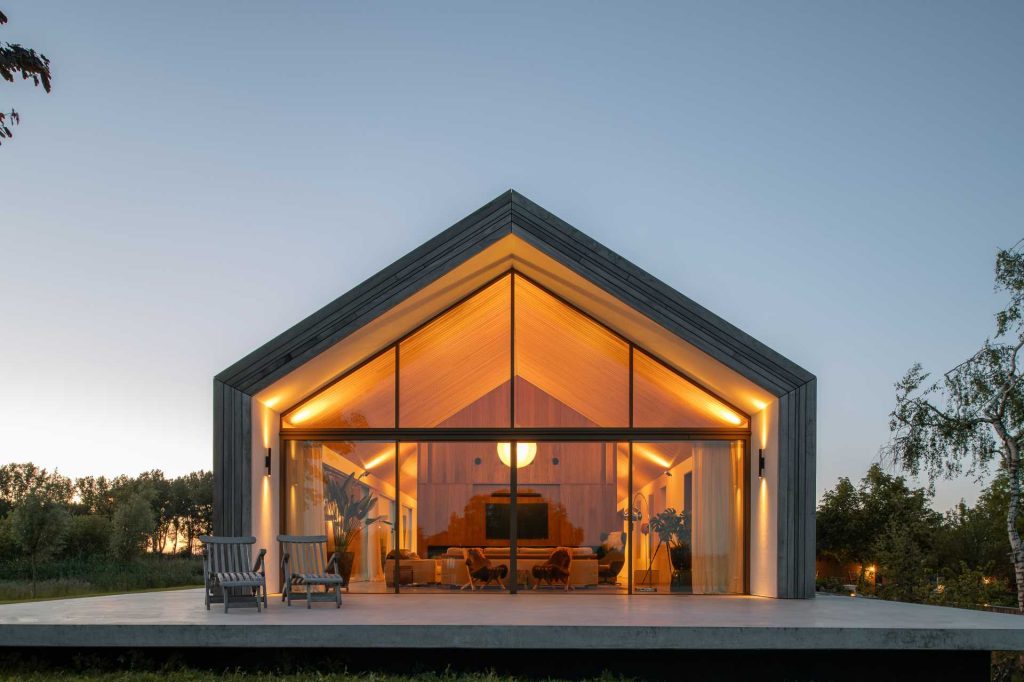
I also argue even further that in today’s energy climate, where solar is more crucial to home design than ever before, that Skillion roofs are a much better choice for solar panels.
Skillions are the most ideal choice for solar panel installs as a skillion roof places the panels in the most upward-facing orientation possible. This means that your panels can work more efficiently for a longer portion of hours of a day. This means more energy collected by your batteries, which means lower overall power bills and lower overall emissions output.
Now yes, Skillions also cut into your roof space making it a bit trickier for sparkies to get in there. But, if you use a Colourbond steel roof, your electrician can slide off the roof panels for access to the cavity. Better yet, add some additional space atop your existing ceiling height, you can make your electrician’s life a heck of a lot easier… Or even better yet, just fit out your home in a way that won’t require you to call out the sparkies later.
Both skillions and gables offer the best protection against leakage as well, due to the fact that there’s less need to cut the materials used to make a roof at weird angles. Since all that’s needed for these roof types is to cut the material to length, provided your roofer isn’t a braindead idiot they can pretty much maintain these roofs from leaks easier than any other kind. There’s no valleys for water to accumulate, and as I previously mentioned, when it comes to buildings at large, I fucking hate water due to its nature to get in places you don’t want it to go, accumulate and cause all sorts of headaches for you.
Provided too that you fit high capacity guttering systems to these roofs as well, they’re less likely to cause structural issues down the road with water runoff and pooling. Provided your builder doesn’t cheap out, Gabled and Skillion roofs are great at just dealing with everything that is thrown at them.
Hipped rooves in addition, also lack the potential to have cost-effective eaves put into them, unless you decide to fork out additional costs. Skillions are easier to design eaves for, because you don’t have to factor in things like barge capping or ridge capping. Instead you can simply extend the width and length of the skillion to suit, and clad it appropriately. This in a sense, gives you built-in-awnings for your home to shield any windows from incoming heat and light from the sun during the hottest parts of the day… There’s also something else you can do to cool your home down, but that’s a rant for later on.
Now, on the topic of cheaping out, here’s something that doesn’t just shit me, it shits pretty much everyone else i know.
Bugbear No. 7: Rendering, but only on the front and rear faces.
Nothing says your builder is a cheapskate quite like a job that is half-done. I’m sorry, if your builder puts render atop the bricks on only the exposed areas of the house, their heads need examining and their pockets need to be rifled for your money. Seriously, nothing tells me your builder did a half arsed, cost-cut job quite like having rendering only on the front and rear of your house.
I get it, you want to save a buck or two. But it just screams “total cheapskate” to me. You could’ve gone with a much more sensible lightweight construction if you wanted to save a buck or two, or better yet, just picked a brick that looks less shit (i’ll get onto that in a minute) , but nope, you had to have the rendered brick look, and your builder took you to the cleaners, didn’t they.
So, what’s my fix to this issue?
Expose your bricks.
To me, if you’re gonna build your home out of bricks, embrace the brick look. bricks look sick if they’re paired with the right contrasting material, beit the right mortar, appropriate cladding etc. Two of my favourite buildings in Perth for example, use the brick look to a stunning effect.
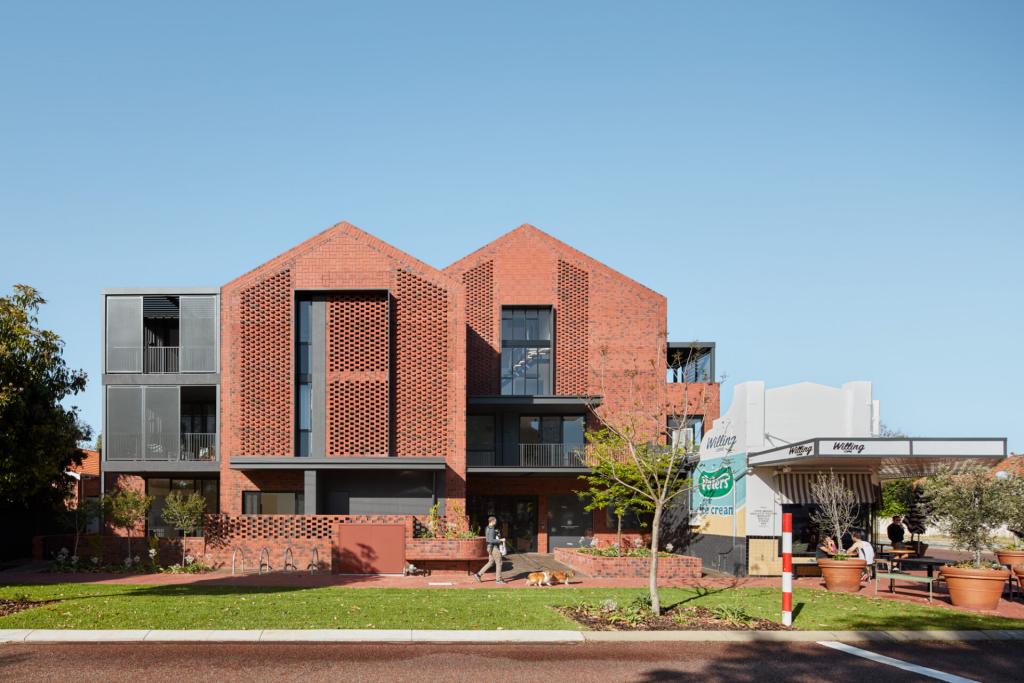
These are the Clifton and Central apartments in Mount Lawley. The architects at MJA Studio here fully embraced the brick look by contrasting it with industrial-esque steel and aluminium clad elements that scream “modern loft” more than they do “70s public housing”

Then there’s this one, The Terrraces by Woods Bagot here in South Perth. Once again, using bricks to a stunningly dramatic effect, coupled with Ebony-coloured Knotwood cladding in the ceilings of the balconies, green roofs above the cafes and stores below, and raw, sealed concrete for that grungy industrial look. It’s a brick sandwich which strikes a contrast from the Nouveau-Riche contemporary architectural designs of the apartment blocks around it, and ties those designs in with the more classic 60s-80s era designs of other apartments in the area.
To me, if you’re going to use materials, embrace them and show them off! Let concrete look like concrete. Let bricks look like bricks. Let timber be timber (unless it’s exposed to water, then in that case, Knotwood is just fine)
If you want your house to be made of bricks? Show those bricks off! better yet, go all sustainable and opt for recycled bricks as they oftentimes end up looking way better, and if all you intend on doing is using them as a cladding or veneer, that can work out just nicely for you.
Now speaking of cheaping out on renderings… Let’s talk about one thing that absolutely shits me with modern builders.
Bugbear No. 8: Poor quality included appliances and fixtures.
Recently my partner purchased a brand new car for herself. Yes, it’s an ICEV, but it’s about as close to an EV that an ICEV can be for the price, in my opinion. Probs will write an article about it later.
When we were at the dealership, we got asked to go into another room before we were allowed to pay for the car, where someone put out a whole spiel about how much it’d cost to put a dashcam and window tint into her car.
Anyways, we did what any reasonable person would do. We shopped around, got quotes, and lo and behold, the cost for the tint was cheaper, and the quality of the dash cam we could get for the same price was way, way better than the offering the dealer provided.
This goes without saying that the appliances your home likely comes with are going to be pretty mediocre for the price. You could probably get better quality upgraded appliances for the same price if you decide to purchase them yourself.
Case in point, a couple of my friends built a house a few years ago now. They went with the “upgraded” appliances with this particular build, but unbeknownst to her, those appliances come from some random no-brand company i’ve never even heard of, and those upgrades cost her a pretty penny, and probably made the builder a decent bit of cash too.
So, what’s my fix to this issue?
Opt to install your own appliances, but shop around and compare specs.
Now don’t let your builder bullshit you. You can indeed build a home without appliances being installed for the purposes of lockup, as the construction codes only require “facilities for preparation and cooking of food“, meaning that you could, theoretically, just have the cabinets be left bare, and have your oven and cooktops installed after you take the keys to the house.
Most builders can also install the appliances you specify or purchase for them, for a fee (usually about 5-10% of the cost of the appliance being installed)
Better yet, if you want greater control over what goes into your home and you don’t mind getting your hands dirty with a little paperwork, opt to become an owner-builder. That way too you can have one engineer, one concreter, one sparky, one plumber, one roofer, and one tiler to work with to keep your labour costs nice and low. This of course, requires you to get an owner-builder’s license, and learn a little project management skills, but in my opinion, the savings could very well be worth it especially if it means you end up with a better quality house in the end.
Some builders (Fox Modular comes to mind) opt to put somewhat decent quality appliances in as standard (Fox uses Westinghouse off the top of my head), so it pays to do some research before you decide to pull the trigger on certain appliances. On top of that, if you prefer to keep all your appliances in one ecosystem (say you opt to go with Bosch because they cover pretty much every appliance class, and sell appliances that’re decently reliable) that might work in your favour if they offer some form of internet connectivity for remote control.
And for the love of fucking god do not get a Smart Fridge. Yes, let’s bolt a tablet that’s going to be made redundant in like, two years to an appliance that is designed to last at least ten years, that bugs out often and sells your data to the highest bidder to serve you ads. What the fuck could possibly go wrong with that idea?!
As for taps? Look for a decent mainstream tapware brand in your build. Methven (this one especially), Oliveri, Abey, Clark and Caroma are all brands I, and my ex-plumber mum, can recommend you fit into your home. As for sinks and toilets? Well, whilst they’re effectively different tubs for your water, Franke, Clark, Oliveri or Abey are also great brands to look for on your spec sheet. Also you can absolutely DIY doing your tap fitting yourself. The only things you cannot do are anything that runs through a wall or floor. That means Toilet DIYs are a no-go, but putting in your own taps or changing a showerhead is absolutely doable, provided the fittings on the wall are already terminated.
Before you sign that line on inclusions, check those specs before you proceed.
Bugbear No. 9: Electrical fixtures and their placements.
Now, I am a finnick for electrical fixturing when it comes to power switches. To me, if it isn’t Clipsal or one of the other Schneider brands, it goes in the garbage. In particular I love the Clipsal Iconic series because if you choose to build out a smart home, you can automate the switches instead of the lights using Zigbee based switchgear.
Now, even if you don’t want to pony up for Clipsal Iconic gear, at least do me one favour.
When it says “Double power points throughout” on your inclusions, especially if you are building a brick home, for the love of all that is holy, opt for at least quad-gang GPO power points throughout your home.
Why? Well, I think powerboards are unsightly, ugly, and most of all, potentially unsafe. Whilst yes, anything that carries an ECM mark is technically safe according to the Australian Standards, it’s much, much better to have your appliances connect straight into a wall socket as opposed to connecting to a powerboard.
In addition, I want you to make sure your builder puts a power socket into your laundry sink cabinet, or at least have an additional laundry socket installed at 300mm off the floor. Get them to at least install a double-gang unit for this lower mounted one too.
Why? Well, even if you don’t opt for them to build out a laundry with a benchtop from the get-go, having two sockets down below in your default laundry cabinet trough (which does have to come with your house, FYI, thanks NCC) or below the benchline (usually sits at about 900mm off the floor) means you won’t have ugly, unsightly wires poking through your benchtop, or better yet, you won’t need to make your sparky cut out a channel to chase cables into your newly painted and plastered brick walls.
This can help you save literal thousands off the cost of doing your laundry build if you opt to not have your laundry built-out from the get go. Yes, it’s a bit of extra work. Yes your sparkies will have to run additional cables. But it’s worth it to have a cleaner looking laundry.
Now. Last, but certainly not least…
Bugbear No. 10: Dark coloured roofs.
Who in the fucking god damn shit thinks this is a good idea in Australia?!
Australia has some of the hottest summers on the planet, and we’re often regarded as one of if not the sunniest country on the planet. So again, i’m going to have a little ranty-poo about how your roofing choices are actively killing the planet. No I’m not crazy, the doctors had me tested.
Western Australia, and Perth in particular, is a massive victim of what is known as the Heat Island effect. This is due to the fact that large swathes of our urban environment, and also combined with our massive urban sprawl, lacks the tree coverage and shade needed to combat this effect in the height of summer. On top of this, builders oftentimes choose to fit dark coloured roofs to fit in with modern architectural trends. and whilst a dark roof can help reduce your heating costs in Winter, the truth is, you can always rug up in winter and add more layers. In Summer, there’s only so much you can do to cool yourself off without getting arrested or ponying up the dosh for using your air conditioning.
So, what’s my fix to this issue?
To add on to my gabled roof rant earlier, opt to have your roof in a lighter colour.
Even if you want the more contemporary dark roof look, you can always cap your roof with black or dark coloured capping, and go with light coloured flat roof panels. Why? Well, you can always hide the appearance of a light roof with said capping as it’s out of your line of sight.
Now granted, I did mention something about cheapskate builders hiding treatments so they’re also out of sight (rendering bricks only where they’re seen) but this is not cheaping out. Light and dark coloured Colourbond steel sheeting costs the exact same price.
I’d even argue that opting to go with lighter coloured materials overall is better for your bills, as once again, it reflects heat away from your home. Especially if you’re a big fan of steel frame constructions and tin roofs.
Alright, I’ve made my point… for now.
I mostly wrote this article as a way to basically preserve my thoughts on home design for when the time comes for me to build my next home. I might do another one of these at a later date, I might opt to have a ranty-poo about things that annoy me in cars (including my own Tesla), or better yet, I might actually talk about some stuff in modern home designs I actively love to see and would want to put in my own designs.
Until next time, thanks for reading. Here’s hoping things stay relatively easy for me to keep writing stuff like this. This is supposed to be a design blog after all, and I am really, really getting sick of living in interesting times.
Stay safe and have a good one.
Beano out.