ooooo look, Shiny new review jump button! I’ve been learnding how to use WordPress better, i have!
I’ll be including these in to my articles for those who want to skip my sometimes off-topic bits. Sometimes the Autism gets the better on me and I get into a bit of a state of infodumping, and I know some people really don’t want to read that sorta stuff.
So, if you want to skip the first two parts of this article, feel free to smack that button and get stuck right into the review. But I do recommend you keep reading on. It’s important stuff that might help you make a better decision about an EV in general, especially since we are in current times ™
Prologue: The state of affairs right now.
So. To kick things off, I’m going to start this article off with a pretty poignant photo, showing the sign of the times right now.

That’s my Tesla, parked at a servo. I was coming back home from the carwash, when i pulled in to top up my tires, top up my washer fluid and pick up some 7-11 Onigiris for lunch (I’m really glad they make those, by the way. I miss Japan so much and their Onigiri really hit the spot.)
Currently, as of the time of me starting to write this article, the price of oil is sitting at $93/barrel for Brent Crude. Yes, that’s within the margin of what is considered to be a decent price, but it is indeed pushing it. As this article explains, using a scene from the hit TV Series “Landman” , when the price of oil goes into the $90-$110 range, the pressures on the global economy begin to mount as the cost of everything begins to go up. This means even us EV owners can’t be all that smug, especially since the cost to truck all kinds of goods will go up in price.
In my previous article I mentioned that our global economy depending on this finite, non-renewable, non-recyclable-when-burnt resource is not a sustainable or feasible idea in the coming century ahead. Indeed, the war in Iran is at least, in my opinion, the shove that marked the beginning of the switch to the renewable economy, and it’s now, more than ever beginning to make economic sense to switch to renewable, self generated electricity, or at least electrically powered transport. This is mostly because if the energy used to power the grid gets cleaner, the cars, trains, trucks and buildings powered by the grid also become cleaner as a result.
My mum, bless her heart (in a good way, love her to bits, lol) has always been of the belief that you power a car by petrol. You go to the servo, you fill up the car, and you keep on driving. She never really got the idea of EVs, until fairly recently, where she said to me that she was spending $200 a fortnight over the past six weeks to fill up her current Hyundai Kona, a relatively fuel efficient ICEV all things considered.
Now granted, the Kona is a cracking little car that I personally love, the Electric version even more so. But, as of recent there’s been this huge wave of Chinese EVs hitting our markets and taking Australia and subsequently Europe by storm. Compared to the first wave of Chinese ICEVs which were often regarded as being tinny, unreliable and poor quality, this second wave of Chinese vehicles hitting the market are higher quality, more reliable and more importantly, more desirable in some ways, than their European and American counterparts, especially given some of the questionable views of the CEO of Tesla. (Here’s an article about why you can and should still buy one if you disagree with him, btw.)
So colour me shocked, when I was waiting in line to see my partner become an Australian citizen at her Citizenship Ceremony (congratulations to her, btw. She bloody well earnt it!), when i got a phone call from my mum, my “Petrol is the only thing that goes in cars” mum, saying something i thought i’d never hear down the line.
“I’m test-driving a BYD!”
I asked her, in shock, “What do you think about it?”
She responds “I love it, I wanna buy one!”
Fast forward to today, where now I see A 2026 BYD Atto 3 Premium in Frost White, parked in her driveway. Honestly, i’m just as shocked as you are. But then again, her reasoning is honestly pretty valid. It made economic sense for her to go this way, especially given how unstable fuel prices are, and how rock-solid power prices have been, It makes perfect sense for her to buy an electric vehicle in this day and age.
Honestly, There is a good reason why this vehicle is right at the top of most people’s lists. The BYD Atto 3 is for all intents and purposes, one of the best EVs on the road that you can buy.
Part 1: Why my mum went electric, and a little bit of a geopol and automotive history rant.
So my mum’s always been a bit of a pragmatist.
She’s dealt with a lot throughout her life. A tough childhood filled with pressure and loss, growing up in hot, humid climate of Darwin with its thundering wet seasons and scorching dry seasons, Living through and surviving Cyclone Tracy, which was one of the worst natural disasters in Australian history, living in the economic hell of the late 1980s and early 1990s, living through the GFC, she’s no stranger at all to dealing with crisis. I speak all kinds of positive things about her on this blog because she has a lot of qualities i wish a lot more people had. We might disagree on some things, but that’s the thing. If you spend your life finding faults, you’ll never find anything good in anyone or anything.
We all know what my views on things are. Heck, i’m unashamedly political on this blog, but mostly because I read a lot into history, and try my best to get as close to “correct” (whatever that may be) as I can. I too, make mistakes. We all do. That’s what being human is, and that’s how we learn. We learn from the mistakes of the past… Sadly there’s two people who refuse to do this that’re kinda screwing the pooch for all of us right now.
The current oil price crisis is being caused by the whims of two politically bankrupt madmen in the form of Benjamin Netanyahu of Israel, and Donald Trump of the United States. These two mad kings see Iran, one of the world’s largest oil producers and one of the oldest extant civilisations on the planet, as a political and economic threat to the so-called “free world”. The US sees China, Iran’s biggest beneficiary, as a direct competitor, and sees the Iran war as a way to kneecap his geopolitical enemy, the Geopolitical enemy that the US created during the Cold War, mind you.
Israel sees Iran’s funding of proxies in the area, notably Hamas in Palestine, Hezbollah in Lebanon, and the Houthis of Yemen, as a direct threat to their security. Never mind that All three of these organisations exist purely because of previous military and political incursions by the Israeli government to destabilise and occupy these nations. (Go google this in your spare time. It’s really quite tragic and has many parallels to what i’m about to say below about the US and China)
To get even more in the weeds too, Richard Nixon propped up China and established American diplomatic relations with the People’s Republic due to it acting as a ever pressing wedge between them and the Soviets in the 1970s. The Split began in the late 50s and came to a head in the late 1960s, due to ideological differences between Maoists and Stalinists/Leninists over how Communism through the state (ie, not true communism) should be achieved. The US, Sensing blood in the water, decided to back Mao and subsequently Deng Xiaoping to create the current China we see today. The US got cheap labour without union overreach for manufacturing (thanks to the CCP seeing Syndicated Unions as a threat to their political power), and in exchange, China got the capital it needed to develop its economy and fix the mistakes of Mao’s Great Leap Forward.
We wouldn’t have Chinese EVs today without America’s shift to outsourcing its magnet and mineral processing, amongst its other dirty industrues, which China themselves eventually learn to clean up.
It’s this mutual exchange between China and the US in manufacturing that created the company, which created the Atto 3 that Mum drives now. If it wasn’t for Tesla being allowed to come in, without a Chinese partner to be the standard bearer for EVs today, BYD would still be producing cars like the e6, a first-generation Chinese EV that was notorious for having all kinds of issues due to its roots, which i’ll get to later.
But BYD is not aiming to be the Tesla of China. You can look at companies like Xpeng for that. Xpeng, also known as Xiaopeng, is a company that is trying to ape Tesla in pretty much every way, even going so far as to develop its own “me-too-Optimus” program.
By contrast, BYD is aiming instead to being a direct competitor to Toyota, as opposed to trying to take on Tesla. This is because BYD understood that Tesla learnt a lot from its beginnings with Toyota.
In fact, the Fremont factory where the Model S and X were originally made (RIP to the EV GOATs) was formerly a Toyota factory, and a part of the deal struck between Tesla and Toyota was for Tesla to work with Toyota to electric-convert a bunch of Rav4s with Tesla Hardware to comply with California’s Cap-and-Trade emissions scheme, which ironically enough, is now in force with Australia’s new Emissions Standards for cars (we nicked the idea off of CAFE).
It’s why you can find Tesla LDUs ripped straight out of the Model S inside Second-gen Rav4 EVs. This in turn, created one of the first ever viable electric compact SUVs.
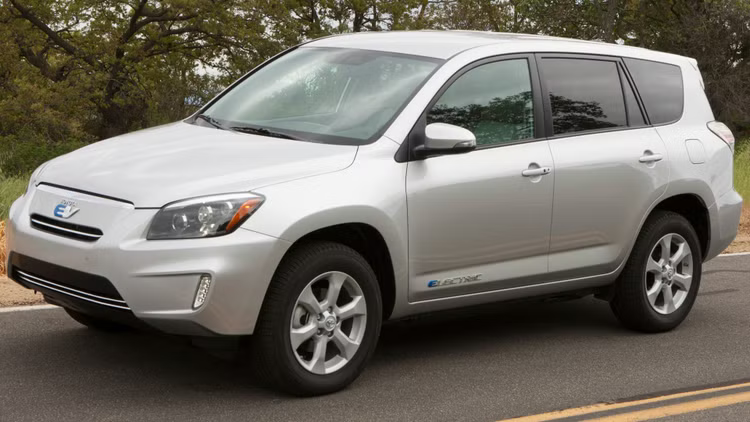
Fast forward to today, Toyota is now directly collaborating with what the world sees as Tesla’s biggest rival, BYD, to produce EVs for the Chinese NEV market (what China calls PHEVs and EVs).
When a company like Toyota, a company famous for cautious, trepidatious decision making, and building ultra durable, ultra reliable cars, on the part of it being one of the most well-established, and deeply Japanese companies on the planet, decides to partner with BYD for automotive development? Well you know that brand’s going places.
Toyota has a reputation of being the unshakeable, unstoppable, unbreakable car company. Tesla learnt how to build efficient production lines from them. BYD is teaching them how to implement battery technology into their cars, and Toyota’s teaching them how to up their build quality game, which leads us to the incredible reputation that BYDs have today.
The auto industry at large, is a collaborative and competitive effort at the same time, because auto-making is hard. Super hard. BYD is however, no stranger to competitive markets.
So who the bloody hell even is BYD?
BYD, Inc was never always called BYD. In fact, it used to be called Yadi Electronics, named after the Yadi village in the city of Shenzhen in China’s Guangdong province. It added the “Bi” character to the start of its name as a tactic to get favourable, top-of-the-list placement at trade shows and exhibitions, in the same way that a Tradesman will call their business “AAA Electrical” to get their name higher up in the phonebook back in the day.
BYD’s backronym, “Build your Dreams” refers to their manufacturing capability as a producer of electronics, energy storage and vehicles through their massive network of interlinked companies. They initially began as a company producing lithium-ion pouch cell and prismatic cell batteries for consumer electronics such as cellphones and tablets.
They then expanded into becoming a generic electronics assembler, akin to the likes of Foxconn, and is now currently a key supplier to Apple for manufacturing capability. If you’re reading this article on a lower-tier iPad (such as an iPad Mini or iPad 10th/11th Gen), you’re likely reading this article on something that BYD has assembled for you.
BYD Auto was established in 2003, when it took over the operations of a failing state-owned car manufacturer during the first wave of Chinese car exports in the early 2000s. In 2009, BYD’s first ever EV, the BYD e6 was made. The e6 made its way to Australia in 2016, with a starting price of $80k, and an interior ripped straight out of the mid 2000s. It also showed up with a GB/T connector, making it incompatible with the ChaDeMo/CCS2 based DCFC network that was around at the time.
Fast forward to today, and BYD has overtaken Tesla for global vehicle sales, and is in fact, coming after Toyota next here in Australia. The second wave of BYDs have been absolute hits due to their low cost, high build quality and their reliability. Tradies love the Shark 6 for its ability to power site tools with its V2L ports, potential Model 3 buyers love the Seal as an alternative for those who want to get all the benefits of a Model 3 without the dodgy political comments that come from naysayers thanks to Elon’s antics, and my mum, has now fallen in love with an Atto 3, one of the best-selling midsize SUVs on the market today, let alone it being Electric, due to its characteristics and how it fits into the way she lives.
Bloody hell, again with the tangents? Tell us why she bought the damn car!
Okay. I’ll cover the driving characteristics in a bit. Mum decided to buy this BYD for one simple reason.
Petrol prices change rapidly. Electricity prices don’t.
In Western Australia we have a pair of state-owned, residential power monopolies depending on the region you live in. In the South West Interconnected System (or SWIS for short) we rely on power generation from Synergy. In the areas past Lancelin, outside of the SWIS, Horizon Power manages those. Both companies are owned by the WA Government.
Most power generation comes from local energy sources. Power plants are usually powered either by a nearby coal mine, a connection to an existing gas well, or by means of renewables, you know, solar, wind, hydro and so on.
In WA at least, we have a heap of gas (most of the petroleum fields to the north of our state are gas fields, with a small smattering of oil producing platforms), and a heap of coal (Collie’s got a massive coal mine which fires our two coal-fired power stations.)
Australia as a whole, imports 90% of its oil. (as i mentioned in this article) The reason is that Australian oil fields just aren’t very big or very productive. We do produce the right kind of oil for diesel and gasoline fuel production (light, sweet crude oils) , but most of it is in areas where it is closer to asian cities for storage and processing (in the northern shelves of Australia), or in areas whose fields are too small to provide fuel to the general continent (such as the oil fields in the Bight and in the Bass and Tasman straits.) The other alternatives are environmentally destructive, politically unpopular and catastrophically expensive shale oil fields, which are in areas where critical water aquifers are located. Water is even more scarce than oil here, and the last thing you want is spicy water, especially if you’re a farmer and intend on using said water to grow crops.
Therefore, geography is unfortunately, our biggest achilles heel when it comes to oil production. The fields that can provide us with fuel are simply too far away from where we actually need it, or too expensive and environmentally dangerous to extract from. Geography begets economics, after all.
We do however, have a more abundant energy source that is less environmentally damaging, and is more easily transported, natural gas. For us residential consumers here in WA, this is thanks to the Dampier to Bunbury gas pipeline, which was first built in the 1970s, and supplies gas to the peaker plants necessary to power our state during times of higher demand, at least right now anyways.
Gas is super cheap to transport, and with the help of compressor stations, you can easily get that gas all the way from up north where it’s extracted, to down south in Perth relatively cheaply, and provide gas power to peaker plants along the way in regional towns that need it.
In addition, also have a metric shit-ton of renewable grid capable minerals. The batteries in both my Tesla and mum’s BYD are powered by Lithium Ferrous Phosphate (LFP) cells. Australia produces half of the world’s available Lithium, and 36% of the world’s Iron Ore, both of which are needed to make these incredibly stable batteries.
China has the facilities in place to be able to refine this into usable LFP, that gets made into EV batteries that’re put into cars and battery packs, and sold back to Australian households.We also have one of the biggest potentials for both decentralised and gridscale solar energy on earth thanks to said resources, combined with the level of Insolation we have down here.
The fact that LFP cells are also cheaper to make than their NCM/NCA equivalents also is a boon for us too, because that makes the biggest cost of an electric car, its battery pack, way cheaper.
This, combined with the fact that Unlike Tesla, BYD makes the batteries, the electronics, the bodies and the components of the car in house, means that BYD can sell a car with a 60kWh battery pack (the same size battery that’s in my Model 3), for $20k less than my car, and $25k cheaper than an equivalent Model Y.
Mum’s lifestyle is also pretty conducive to EV ownership.
Now like a lot of us, she drives to work, due to the fact that her workplace is in a light industrial estate. However, she drives no more than 300km in a week to do this. An overnight charge off of a power socket, or a weekly 100% charge off of a dedicated L2 EVSE would more than suffice, given the Atto 3’s 16.5kWh/100km consumption figure.
Probably the most difficult thing for her would be her trips up to my Sister’s house, which is a solid 1 hour north of where we live and work.
But, given this round trip only drains about 30% of my Tesla’s battery on a round trip (thanks to the Model 3 Highland’s Godlike efficiency), and given also that she tends to stay overnight at my sister’s house on those trips to look after the Kids while my Brother-in-law’s away working, the fact that she could grab an overnight charge while they sleep, and wake up the next day with 300km of usable range off of my Sister’s newly installed battery storage array, means that she can likely go further than what her existing Kona would be capable of going on those days anyway.
The real benefit of pluggable vehicles is that wherever there is a power socket, there’s a fuel source. Even if it’s a slow charge (which is better for your battery anyway), the universality of the grid means that wherever there is energy, there’s driving range. No need to worry about going to the servo when your house is the servo.
I’m getting sidetracked here. Let’s get in to actually reviewing this sucker, shall we?
Part 2: Driving a BYD for the first time
So, if you’ve decided to click that button at the top of the page (you cheeky sod, dw. I get my rants can be long and annoying sometimes for some readers, hence the button), or you’ve managed to eat your historical vegetables, it’s time for the slow cooked, deliciously smokey barbecued meat of the review. Yum yum.
So. What’s the Atto 3 like to drive? In short, it’s nice. I can see why mum fell in love with it.
Having driven both her Kona and of course, my Tesla previously, I can tell you that the experience of driving the Atto 3 is somewhere in the middle of these two cars. The Kona she used to own was AWD, but it was only AWD under heavy acceleration or in dodgy weather thanks to its part-time AWD system. In this regard, the current Atto 3 has more in common with the Kona than the Model 3 does.
0-100kph is handled in about 7-ish seconds, which is pretty brisk for a compact SUV. It’s dwarfed by comparison by my Tesla’s 6 second 0-100 time, but most of the time, I don’t drive my car in the mode that would enable that (Standard mode) unless i need to pass a truck. In a side-by-side sprint to 100kph, My Model 3 in Chill mode and the Atto 3 would be neck-and-neck. More than adequate for a daily driver. It matches the 0-100 time of her previous Kona with ease.
However, what matters in EVs is the midrange acceleration. Due to an electric motor’s borderline instantaneous torque delivery, it means midrange sprints (what’s needed to pass trucks and other cars) are where EVs really shine. Passing trucks in the Atto 3 feels just as good as my Tesla. Bury your foot into the carpet and pass with ease.
The regenerative braking in the Atto 3 is a lot more restrained than my Model 3. Don’t get me wrong the regen in a BYD is still there, but even in Eco mode, it’s not a true one-pedal drive like a Tesla is, even if said Tesla is in chill mode. It behaves a lot more like a conventional petrol-powered vehicle or perhaps a Toyota Hybrid in B mode. Once again, they’re not coming after Tesla, they’re aiming squarely at Toyota and Hyundai drivers who might be used to using the brakes normally.
However, like a Toyota Hybrid, the brakes are a blend of both mechanical and regenerative braking, with a bias towards regen and really good blending between the two. With a little anticipation, you can lift off, grab some energy to anticipate the stop, and then if you need to stop more rapidly, you apply the brakes a little more to add more regen and then mechanical brakes to slow you down. In a way, it encourages you to drive smoother, but doesn’t force you to drive an EV like how other EV companies want you to drive. It makes the transition from petrol to electric way, way easier for those who aren’t used to it.
The ride is softer than mum’s old Kona, and is about as soft as my Model 3 is, albeit with less control over suspension frequencies (due to the Model 3’s dual rate frequency response shocks).
Now you might be thinking “Gawsh, that must be horrible. If I can’t feel the road, that’s a sign of a bad car!” the truth is, most people who buy these things want to be comfortable, not connected to the road. They want to not have to deal with potholes, bumps, knocks and wobbles. They want soft, squidgy suspension that feels planted without feeling too bumpy. They want light steering that gives a small amount of road feel, but not so much that you feel like you’re on a racetrack. If you want suspension feel and handling, go buy an MX5.
This combined with the hilariously comfortable heated found on this premium model that give the seats in my Model 3 a run for their money, mean that those with bad backs and rickety bones will find this car a pleasure to drive.
Same too with the driving position. Mum and I are about the same height, 5ft6in, and I drop into the seat with ease. Frontal visibility’s great, but it does have a rather thick A-pillar compared to my Model 3.
Where BYD kerb-stomps my Tesla though is its ergonomics.
Tesla! Are you listening? Give me the goddamn gear selector stalk back. I get that Auto-Shift is neat and all, but i’ve had instances where i’ve fumbled about with the gear selector on the screen causing the car to lurch forward when i intended to select reverse. I shouldn’t have to buy an aftermarket part from Aliexpress to fix a glaring issue this car has, Elon.
BYD thankfully gives you more conventional controls. Indicator stalks, a light stalk, and a conventional shifter! Yay! Please for the love of god, take notes, Tesla.
I also think the fact that BYD gives you a dashboard display is a welcome change from my Model 3. Not needing to look away from the road to see my speed is brilliant.
Part 3: Picking bones.
Now, my biggest bone to pick with BYD’s graphic design is its 2000s era Frutiger Aero/Metro graphic design choices. I get it. It’s nostalgic and fun, but give me clean, well laid out flat design over this, any day. I still think Polestar nails graphic design in their EVs more than both BYD And Tesla combined, but a Polestar is a car for design nerds, not necessarily for those who care about cost or efficiency.
Software updates have improved the overall look, feel and capability of these cars too. They now have the same level of app control that a Tesla has now, with phone key support, remote pre-conditioning control, and the ability to see the status of the car’s state of charge from your phone using the app. Something that you actually have to pay extra for in a Polestar, ironically enough.
As for navigation and App connectivity? Well if you’re a fan of CarPlay, you’re going to LOVE the Atto 3. I really mean it. Seeing CarPlay projected on a massive 15 inch screen is a sight to behold, especially if your eyes are getting old. Tesla? Once again, take notes. Get CarPlay sorted in your cars ASAP. I want this in my car!
…not that you’d need it, the stock Tesla software smashes CarPlay’s capabilities in most ways and the stock infotainment of the Atto 3 is pretty decent, but seeing as BYD took the smart decision and made its OS based on the AOSP (the Android Open Source Project), and it implemented an open source CarPlay and Android Auto client in its OS, it means that there’s also the potential for side-loading aftermarket apps if support for your car is dropped in the future. Once again, Tesla. Take notes.
The other thing that might draw you away from the BYD is its charging speed. At a paltry 85kW, you might think that that’s pretty slow compared to my Tesla’s 170kW. Well, the truth is, at the average Evie Networks charger, both of our cars are going to be solidly pegged at 75kW for a large bulk of the time. Peak charging speed is irrelevant if the charging curve is going to ramp down eventually.
Teslas have quite a conservative charging curve, opting to have a curve that’s fairly linear to reduce stress on the battery over time. Hence why they ramp down more gradually over time and have slower overall 10-100% charge times compared to their Chinese equivalents.
The BYD on the other hand has what I like to call a “Staircase” curve, where it holds a charging capacity for longer periods of time before stepping down. This shows that Tesla has a greater level of control over the charge speed than their rivals, but it also shows that BYD’s strategy is to preserve high charging speeds whilst sacrificing a little wear on the battery due to a more durable overall design. The Blade battery is, after all, a great battery.
Part 4: The really, really good stuff.
Three words. Vehicle, To, Load.
The fact that you can put out 3.3kW from the AC charge port, shows that BYD sees their cars as more than just robotic taxis, they see them as key and crucial parts of a person’s day-to-day energy needs. You can plug in a goddamn welder into the charge port and do jobs on the go. You can power a whole campsite through that port. It’s little wonder why the Shark 6 is so damn popular with tradies.
But there’s another neat and sneaky trick up the sleeves of all BYDs. They are fully compatible with bi-directional charging.
Now you can, with some screwing around, trick a tesla to discharge from its DC port. But once you exceed 4kW of overall draw, the car clamps down on this IMMEDIATELY and thinks there’s a car-breaking fault. Meanwhile, BYDs have been successful in discharging up to 11kW of power to a home.
So, why is this important? Well, easy. Because an EV is a battery too. Take a look at the graph below.

It’s no shadow of a doubt that I personally love the idea of solar and batteries on houses. Heck half this damn blog is dedicated to me proselytising about how fantastic renewables are, but having a battery on wheels with a whopping 60kWh of usable energy storage, where it can be used to soak up and transport cheap, clean renewable energy from place to place, and discharge at times where energy is needed, means that we could, theoretically, use our cars to power our homes on top of existing battery storage.
Think about this scenario. Let’s say, hypothetically, mum and I lived in the same house. Mum would drive to work of a morning with a full battery. Our house also has a battery and is soaking up energy throughout the day, but for one, it’s cloudy out, so we’ve not been discharging much, and for another, i’ve been busy preparing for a party that evening and I end up fully discharging our battery cooking meals and getting our home ready for that evening.
Well, crap. No power in the battery, no time left to recover it. What do we do to save money?
Easy. Plug in mum’s car to cover the remaining charge we need. So long as the battery sits below 98%, the car will push out more than enough power to power the house. She’s only drained about 20% of the car’s pack, meaning we still have a whopping 80% of a 60kWh pack, or about 50kWh, to power the house that evening until the next morning.
As such, it means we can reduce our overall demand on the grid, we can reduce overall power consumption, and absorb more and more renewable energy if we need to. That’s the beauty of Bidirectional charging!
Now sure, Vehicle to load is available in a Tesla. The Model Y L and Model Y Performance both have a lighter version of Tesla’s second gen PCU in them, meaning they can in fact, do Vehicle to Load, however they cannot do Vehicle to Home. That’s only reserved for the Cybertruck, and even then, that’s only reserved for those who have both a Powerwall 3 and a Tesla Powershare Gateway. The BYD on the other hand, does V2H using a standardised protocol that’s internationally accepted. All it’d take is for Tesla to push a single software update to its entire fleet to make V2H possible… But no, Robotaxis are the Future, I guess.
I mean, they are, SDVs are awesome, but it’d be even better if inactive Robotaxis could idk, act like a huge portable battery storage grid on wheels?
Part 5: If BYDs are so good, why didn’t I buy one?
The truth is, I almost bloody well did. The Seal Premium was my number two pick in terms of cars, and I almost bought one. If it wasn’t for its less than stellar efficiency? I would be in one right now.
I still think the BYD Seal is one of the nicest cars you can buy. If you absolutely cannot stomach Elon Musk and cannot put his politics aside to get one of the most efficient EVs you can buy, Buy a Seal. Or hell, buy an Atto 3 Evo. It’s better than a Model 3 in almost every aspect, excluding Self-Driving of course.
Nowadays your choice to buy a Tesla comes down to these three factors.
- Do you need the most efficient vehicle in its class?
- Do you drive enough to justify a subscription to FSD?
- Do you like one-pedal driving?
If you can say no to all three of these questions, go buy a BYD.
I like one pedal driving, and I needed the single most efficient vehicle money could buy, hence why buying a Tesla was my choice. However if I say, had a battery-backed, solar powered, fully electric home, and didn’t need the most efficient vehicle on sale? I’d hands down take a BYD over a Tesla. The fact that I can power my house with my car, especially given my 3-day-per-week WFH lifestyle, means that my car would no longer be sitting at 100% for large periods of time, which is worse for the battery overall.
Whilst a Model Y L is probably still at the top of my recommendation list due to its value proposition, I would actively encourage people to look at the BYD Atto 3, BYD Seal or heck, the BYD Atto 3 Evo especially, as very valid alternatives to Teslas in Australia, simply on the basis of compatibility with bidirectional chargers.
But it once again, depends on what you want. This is the beauty of the auto landscape these days, especially in Australia. The market’s so open and free now, it’s so hotly contested, that you no longer have to buy a Tesla, you’ve got options.
And to those of you out there who are EV Skeptics, I urge you to do what I did in my early days of the Electric Adventure, and go and put your bum in the seat of an EV. I guarantee you, you’ll enjoy the peace, quiet, power and technology that lurks under the skin of these cars. Anyone out there who is saying all kinds of bad stuff about electric vehicles, are simply those who are out to misinform you. They themselves haven’t lived with an EV and refuse to do so.
I am a gearhead at heart. I’ve owned both ICEVs and EVs, both high performance vehicles and total shitboxes, I guarantee you, my daily driver will never be internal combustion ever again. Heck i might go so far as to say that if I ever did get back into performance motoring, I probably wouldn’t do so in an ICEV, i’d probably get into electric motorcycle conversions or perhaps even build an electric hotrod. Imagine a ’34 Ford with the guts of a Tesla sitting in it!
In short, it was mum getting out of her comfort zone, putting her bum in the seat of a BYD and falling in love, that got her to make the leap into the electric world. The economics make sense, the lifestyle factors make sense, and for her at least, she’s thoroughly enjoyed her experience with the Atto 3.
BYD might be the Ford to Tesla’s Holden, but I can absolutely appreciate the good things about what’s on their side. In some ways, like how I lusted for XR6 Turbos as a Holden fan, I really, really like some of the car BYD makes. Toyota, watch your back.
Beano out.